
In the high-stakes environment of aerospace engineering, the difference between structural integrity and catastrophic failure often resides in dimensions invisible to the naked eye. As modern aircraft transition to complex sandwich structures—combining carbon fiber-reinforced polymers (CFRP) with high-strength aerospace aluminum—the demands on fasteners have shifted. Traditional cold-forged screws often lack the geometric perfection required for these hybrid interfaces.
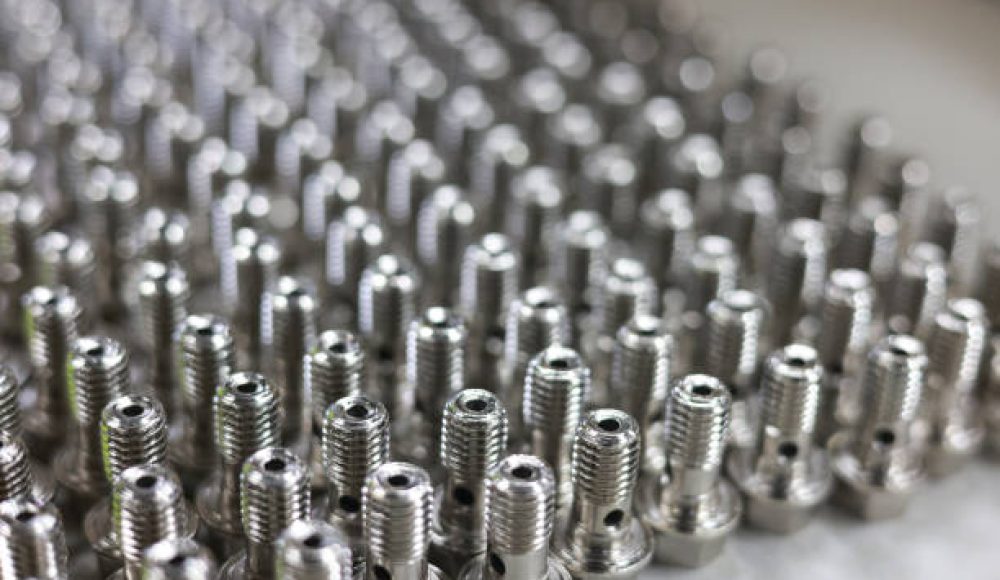
To address the silent threat of “fretting wear,” engineers now turn to CNC-machined aerospace screws. By achieving a staggering ±0.005 mm thread profile tolerance, these precision components ensure a “perfect fit” that prevents microscopic movement. This article dissects how extreme CNC grinding and meticulous control over pitch diameter and lead angles eliminate the gaps that lead to structural fatigue and premature failure.1. The Invisible Enemy: Fretting Wear in Hybrid Structures
Fretting wear is a specialized form of fatigue that occurs at the contact interface between two surfaces subjected to minute, oscillatory movements. In an aircraft, these movements originate from engine vibrations, aerodynamic buffeting, and thermal expansion cycles.
The Composite Challenge
In composite sandwich panels, the fastener connects layers with vastly different mechanical properties. If a screw has even a slight deviation in its thread profile or pitch diameter, it creates a “micro-gap” within the hole.
-
The Chain Reaction: These gaps allow the screw to vibrate against the bore wall. Over thousands of flight hours, this vibration grinds away the resin matrix of the carbon fiber or the protective oxide layer of the aluminum.
-
The Result: This leads to “fretting corrosion” and eventual delamination of the composite, compromising the load-bearing capacity of the entire wing or fuselage section.
2. The ±0.005 mm Standard: Why CNC Machining is Mandatory
Standard industrial fasteners usually feature threads formed by rolling—a process that is fast but prone to “elastic recovery” and profile distortion. In contrast, CNC-machined aerospace screws utilize subtractive grinding to achieve a level of geometric truth that rolling cannot match.
Total Thread Profile Grinding
By using CNC thread grinding, the machine removes material grain-by-grain. This allows for a tolerance of ±0.005 mm across the entire flank of the thread.
-
Uniform Contact: This extreme precision ensures that when the screw is torqued, the load distributes evenly across every single thread flight.
-
Eliminating Stress Risers: In rolled threads, microscopic “laps” or “folds” can act as stress concentration points. CNC grinding creates a perfectly smooth surface finish (often reaching Ra 0.4 or better), which significantly increases the fatigue life of the fastener.
3. Mastering the Pitch Diameter and Lead Angle
The stability of an aerospace joint depends heavily on the “interference” or “fit” between the screw and the nut (or tapped hole). CNC-machined aerospace screws allow for hyper-accurate control over two critical variables: the pitch diameter and the lead angle.
Hyper-Accurate Pitch Diameter
The pitch diameter is the theoretical cylinder where the thread width and the gap width are equal. If $d_2$ is even slightly undersized, the screw “wobbles” within the threads. CNC centers monitor this dimension in real-time, ensuring that the “effective” fit remains constant. This tight fit creates a friction-lock that naturally resists the loosening effects of vibration.
Synchronized Lead Angles
The lead angle (the slope of the thread) must be perfectly consistent. Any “drunkenness” in the thread—where the angle fluctuates—creates uneven pressure. CNC machining ensures a perfectly linear helical path. Consequently, the screw achieves a “perfectly uniform contact” with the composite hole wall, preventing the localized “point loading” that typically triggers fretting.
4. Material Synergy: Aerospace Aluminum and Carbon Fiber
Aerospace fasteners must not only be precise but also compatible with the materials they join. CNC-machined aerospace screws are often crafted from Titanium (Ti-6Al-4V) or high-nickel superalloys to match the thermal expansion rates of the surrounding structure.
-
Galvanic Protection: Because CNC machining allows for the integration of complex geometries, these screws can include “sealant grooves” or specialized under-head radii that help isolate the carbon fiber from the metal, preventing galvanic corrosion while maintaining structural rigidity.
-
Smooth Transitions: The transition from the threaded shank to the smooth grip length (the “run-out”) is a common failure point. CNC machining allows for a “tapered” thread run-out, which smooths the stress transition and prevents the fastener from “biting” into the composite layers.
5. Redefining Reliability: From “Fixing” to “Preventing.”
The move toward ±0.005 mm tolerances represents a shift in philosophy. Instead of designing structures to tolerate wear, engineers are using CNC-machined aerospace screws to eliminate the conditions that cause it.
Long-Term Economic Benefits
While CNC-machined fasteners carry a higher initial cost than mass-produced screws, the Total Cost of Ownership (TCO) is lower.
-
Extended Maintenance Cycles: By eliminating fretting, aircraft can stay in service longer between structural inspections.
-
Weight Savings: Precision fitment allows engineers to use fewer, smaller fasteners to achieve the same structural safety factor, directly contributing to fuel efficiency.
-
Predictable Fatigue Life: Digital manufacturing provides a “birth certificate” for every screw, including data on its exact dimensions, ensuring that every joint in the aircraft behaves predictably under stress.
6. Conclusion: The Foundation of Flight Safety
Aircraft safety relies on countless precision contact points working together. When any point fails, the entire structure becomes vulnerable. Therefore, CNC-machined aerospace screws safeguard these critical interfaces. By holding ±0.005 mm thread tolerances, they prevent fretting wear disruption. Meanwhile, carbon fiber and aluminum joints demand flawless surface contact. Through CNC precision, uniform engagement eliminates gaps. As aerospace design advances, fastener accuracy must lead progress. Ultimately, precise screws ensure every flight reflects reliable engineering.